If you work with IoT SIM cards, industrial routers, cellular gateways, smart meters, CCTV systems or vehicle tracking devices, you will eventually come across the term PLMN.
PLMN stands for Public Land Mobile Network. While it sounds highly technical, the concept is actually quite simple. A PLMN is simply a mobile network operated by a cellular carrier.
For example:
- EE UK is a PLMN
- Vodafone UK is a PLMN
- O2 UK is a PLMN
- Three UK is a PLMN
Every mobile network in every country has its own unique PLMN identity.
Understanding PLMNs is important because they play a major role in how IoT SIM cards select networks, how roaming works, and why devices sometimes connect to one operator instead of another.
What Does PLMN Stand For?
PLMN stands for Public Land Mobile Network.
In simple terms, it refers to a cellular network operated by a mobile operator within a particular country.
A PLMN can provide:
- 2G connectivity
- 3G connectivity
- 4G LTE connectivity
- LTE-M connectivity
- NB-IoT connectivity
- 5G connectivity
Each operator manages its own PLMN and broadcasts its identity through its network infrastructure.
How Is a PLMN Identified?
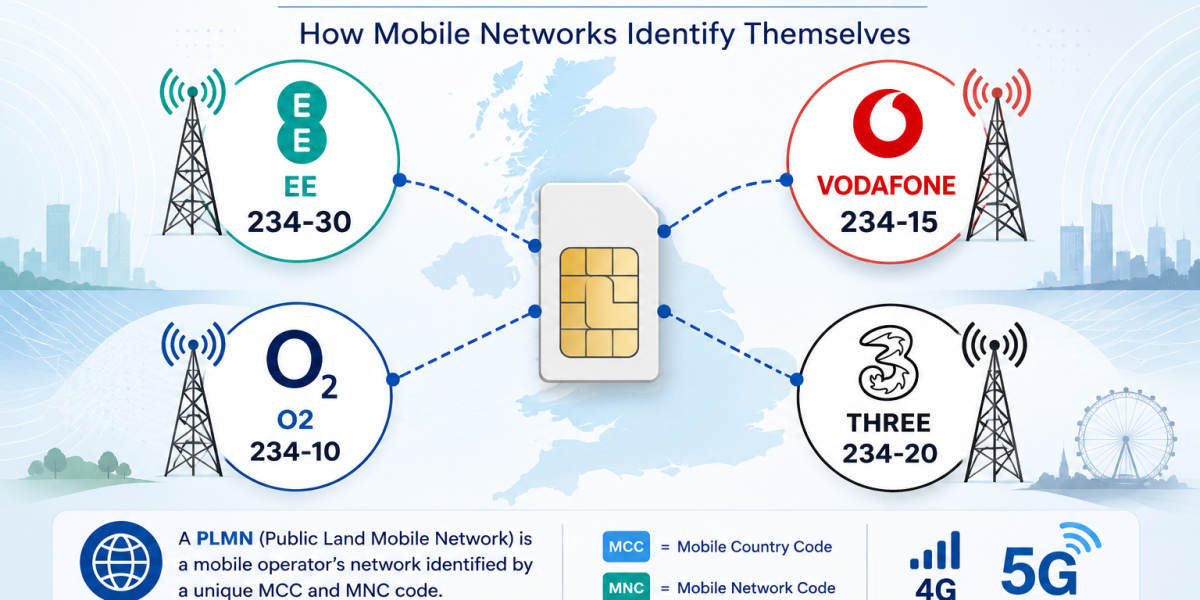
Every PLMN has a unique code consisting of:
- MCC (Mobile Country Code)
- MNC (Mobile Network Code)
Together these form the PLMN code.
Examples:
| Network | MCC | MNC | PLMN |
|---|---|---|---|
| EE UK | 234 | 30 | 234-30 |
| Vodafone UK | 234 | 15 | 234-15 |
| O2 UK | 234 | 10 | 234-10 |
| Three UK | 234 | 20 | 234-20 |
When a router or modem scans for available networks, it sees PLMN codes rather than marketing names.
Why Are PLMNs Important?
When a device powers up it must decide which network to connect to.
The modem scans nearby cellular towers and builds a list of available PLMNs.
It then works through several rules to determine which network should be selected.
These rules can include:
- Home network preferences
- Roaming agreements
- Preferred network lists
- Signal strength
- Network technology support
- SIM card steering policies
This process happens automatically and often within seconds.
PLMNs and IoT Roaming SIM Cards
This is where PLMNs become especially important.
Unlike a standard consumer SIM, a roaming IoT SIM may have agreements with hundreds of networks worldwide.
Instead of only connecting to a single operator, the SIM can potentially connect to multiple PLMNs in each country.
For example, an IoT SIM deployed in the UK might be able to use:
- EE
- Vodafone
- O2
- Three
If one network experiences problems, the modem may be able to register on an alternative PLMN.
This is one of the key reasons many organisations choose roaming IoT SIM cards for business-critical applications.
For a complete guide to roaming connectivity, read our guide:
IoT Roaming SIM Cards & M2M SIMs: The Complete Guide
Why Doesn’t a Device Always Connect to the Strongest Signal?
This is a common misconception.
Signal strength is only one factor used during network selection.
The modem may also consider:
- Preferred PLMN lists
- Forbidden PLMN lists
- Roaming policies
- SIM card steering rules
- Network technology availability
This means a router may sometimes connect to a network with a slightly weaker signal because it has been prioritised by the SIM provider.
Home PLMN, Visited PLMN and Roaming
When discussing PLMNs, you may encounter additional terminology.
HPLMN
The Home PLMN is the SIM card’s home network.
VPLMN
The Visited PLMN is the network currently being used while roaming.
EHPLMN
Equivalent Home PLMNs can be treated as if they are home networks.
FPLMN
A Forbidden PLMN is a network that the modem or SIM has marked as unavailable.
We explain this in detail in our companion guide:
What Is an FPLMN? Understanding Forbidden Mobile Networks
PLMNs in Industrial Routers
Industrial routers from manufacturers such as Teltonika, Milesight, Robustel and Queclink all rely heavily on PLMN information.
When troubleshooting connectivity issues, engineers often look at:
- Current PLMN
- Available PLMNs
- Registered PLMN
- Preferred PLMN lists
- Forbidden PLMN lists
Understanding these values can dramatically reduce troubleshooting time.
Summary
A PLMN is simply a mobile network operated by a cellular carrier.
Every network has a unique PLMN code based on its Mobile Country Code (MCC) and Mobile Network Code (MNC). These identifiers allow devices to discover, select and connect to mobile networks around the world.
For IoT deployments, PLMNs are fundamental to roaming, resilience and network selection. Understanding how they work can help explain why devices choose certain networks, why roaming SIMs behave differently from consumer SIMs, and why connectivity issues sometimes occur.
Next, read our guide to FPLMNs to understand how devices can blacklist networks and why this sometimes causes roaming issues.
[…] What Is A PLMN? […]
[…] Do not trust the friendly name. Routers get operator names wrong constantly, especially on roaming SIMs, because the name is looked up from a table that may not have been updated since the router firmware was built. The PLMN number does not lie. If you want the full breakdown of how those codes work and why HPLMN, VPLMN and EPLMN are different things, we cover it in What Is a PLMN?. […]